
Sheet Metal Gauge Chart: Steel, Galvanized, Stainless and Aluminium Thickness Table (Free PDF)
Sheet metal gauge to thickness in inches and mm, with weight per area, for steel, galvanized, stainless and aluminium, plus tolerances. Free PDF, PNG and CSV.
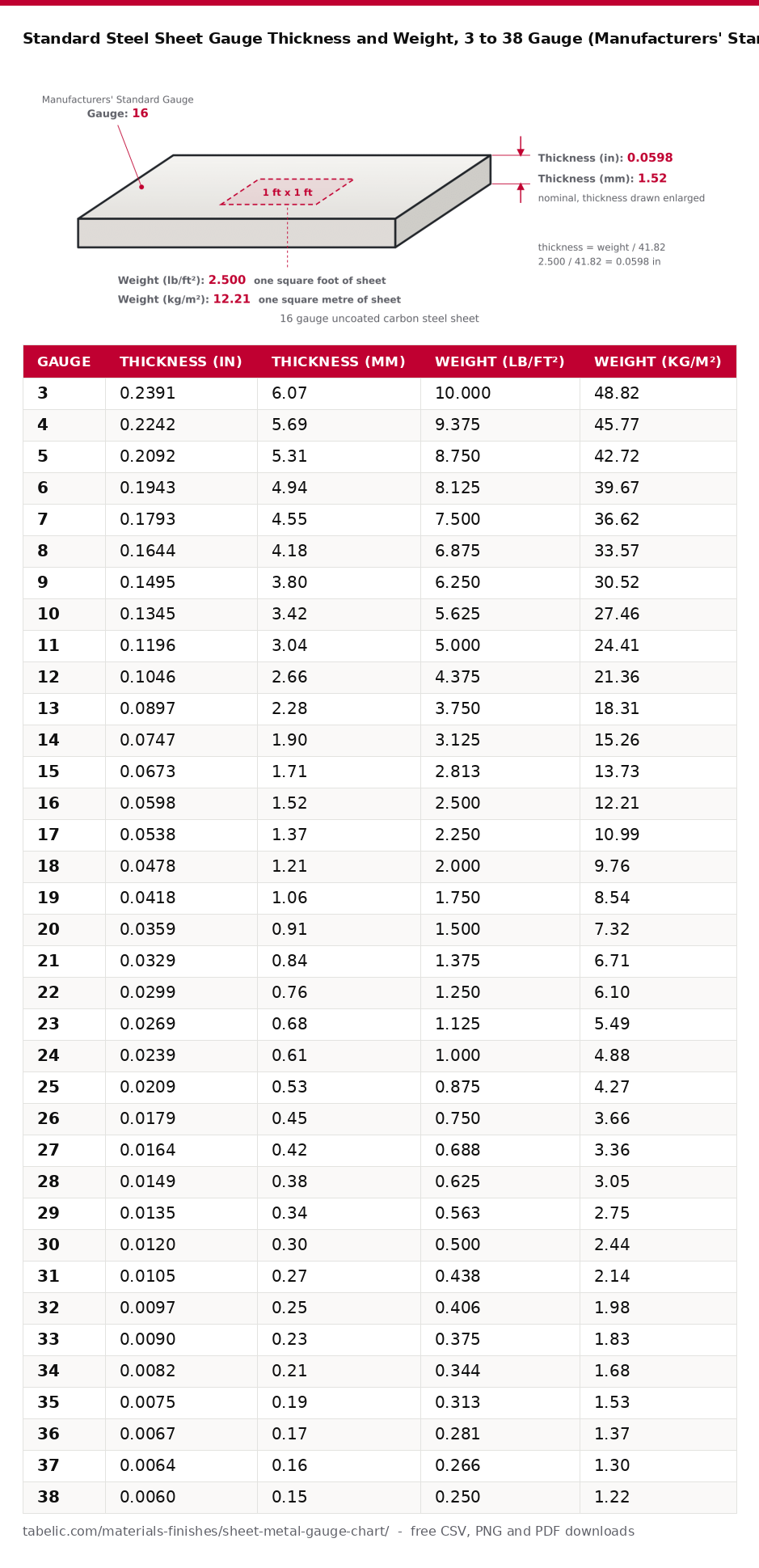
Standard Steel Sheet Gauge Thickness and Weight, 3 to 38 Gauge (Manufacturers' Standard Gauge)

| Gauge | Thickness (in) | Thickness (mm) | Weight (lb/ft²) | Weight (kg/m²) |
|---|---|---|---|---|
| 3 | 0.2391 | 6.07 | 10.000 | 48.82 |
| 4 | 0.2242 | 5.69 | 9.375 | 45.77 |
| 5 | 0.2092 | 5.31 | 8.750 | 42.72 |
| 6 | 0.1943 | 4.94 | 8.125 | 39.67 |
| 7 | 0.1793 | 4.55 | 7.500 | 36.62 |
| 8 | 0.1644 | 4.18 | 6.875 | 33.57 |
| 9 | 0.1495 | 3.80 | 6.250 | 30.52 |
| 10 | 0.1345 | 3.42 | 5.625 | 27.46 |
| 11 | 0.1196 | 3.04 | 5.000 | 24.41 |
| 12 | 0.1046 | 2.66 | 4.375 | 21.36 |
| 13 | 0.0897 | 2.28 | 3.750 | 18.31 |
| 14 | 0.0747 | 1.90 | 3.125 | 15.26 |
| 15 | 0.0673 | 1.71 | 2.813 | 13.73 |
| 16 | 0.0598 | 1.52 | 2.500 | 12.21 |
| 17 | 0.0538 | 1.37 | 2.250 | 10.99 |
| 18 | 0.0478 | 1.21 | 2.000 | 9.76 |
| 19 | 0.0418 | 1.06 | 1.750 | 8.54 |
| 20 | 0.0359 | 0.91 | 1.500 | 7.32 |
| 21 | 0.0329 | 0.84 | 1.375 | 6.71 |
| 22 | 0.0299 | 0.76 | 1.250 | 6.10 |
| 23 | 0.0269 | 0.68 | 1.125 | 5.49 |
| 24 | 0.0239 | 0.61 | 1.000 | 4.88 |
| 25 | 0.0209 | 0.53 | 0.875 | 4.27 |
| 26 | 0.0179 | 0.45 | 0.750 | 3.66 |
| 27 | 0.0164 | 0.42 | 0.688 | 3.36 |
| 28 | 0.0149 | 0.38 | 0.625 | 3.05 |
| 29 | 0.0135 | 0.34 | 0.563 | 2.75 |
| 30 | 0.0120 | 0.30 | 0.500 | 2.44 |
| 31 | 0.0105 | 0.27 | 0.438 | 2.14 |
| 32 | 0.0097 | 0.25 | 0.406 | 1.98 |
| 33 | 0.0090 | 0.23 | 0.375 | 1.83 |
| 34 | 0.0082 | 0.21 | 0.344 | 1.68 |
| 35 | 0.0075 | 0.19 | 0.313 | 1.53 |
| 36 | 0.0067 | 0.17 | 0.281 | 1.37 |
| 37 | 0.0064 | 0.16 | 0.266 | 1.30 |
| 38 | 0.0060 | 0.15 | 0.250 | 1.22 |
Manufacturers' Standard Gauge for uncoated carbon steel (hot or cold rolled). Thickness = weight / 41.82 lb/ft² per inch. Nominal values, see the tolerance table.
Locate your gauge number down the left hand column and move across. There you’ll find the metric and decimal thickness, and also the weight per square meter and square foot of sheet.
This gauge system are limited to uncoated carbon steel. That’s mild steel sheet in either hot rolled, cold rolled, or pickled and oiled condition. For aluminum, stainless, or galvanized sheet, refer to the table for that material. Those materials has a different thickness for the same gauge number.
The manufacturers' standard gauge is the gauge number. A smaller number mean the material is thicker. Nominal thickness is shown in inches and mm. The weight per square foot in pounds is the value that defines the system.
Originally, it was weight per square foot. Divide the weight by 41.82 lb/ft² per inch to get the thickness. That's the average density for rolled steel. Weight is in kilograms per square meter, which is same value in metric units.
Because this is a weight based system, the steps aren’t even. Between 3 and 14 gauge, each step (number) are 0.625 lb/ft² away from its neighbor. For example, 13 minus 14 = 0.625. That’s roughly 0.0149 inches.
At the thin end, the steps almost touch, coming down to a few thousandths of an inch. Don’t guess between gauges. Don’t think that one gauge is some percentage thinner then another gauge.
The lb/ft² value can used to calculate sheet weight: multiply it by the area. For example, a 16 gauge 4 x 8 ft sheet has an area of 32 ft². Multiply that times 2.500 for 80 lb. A 16 gauge 1000 x 2000 mm sheet has an area of 2 m². Multiply that times 12.21 for about 24.4 kg.
These are rough nominal estimates, because real sheet varies with rolling tolerance. Use these for shipping and handling only; do not use in any way for structural calculations.
This is the nominal thickness. The sheets is rolled to a certain range. For example, a 16 gauge sheet may be anywhere from 0.0548 to 0.0648 inches thick. So if you measure with a caliper and get .057 inches, that doesn’t make it 17 gauge. Refer to the table below for tolerances.
ASTM sheet specs actualy encourage against using gauge numbers in general. Specify either the metric or decimal thickness on purchase orders and drawings. Use the gauge number for reference purposes only.
This table does not apply to steel plate. Normally, fractional inch thickness are used for ordering plate. It also does not apply to tubing or strip. They commonly use the Birmingham (Stubs) wire gauge. With that system, 16 gauge = 0.065 inches.
Neither does the table apply to the older US Standard Gauge of 1893. That is the basis of the stainless table. See Sheet Metal Screw Size Chart for fasteners that will be going in this sheet. You should of checked the spec.
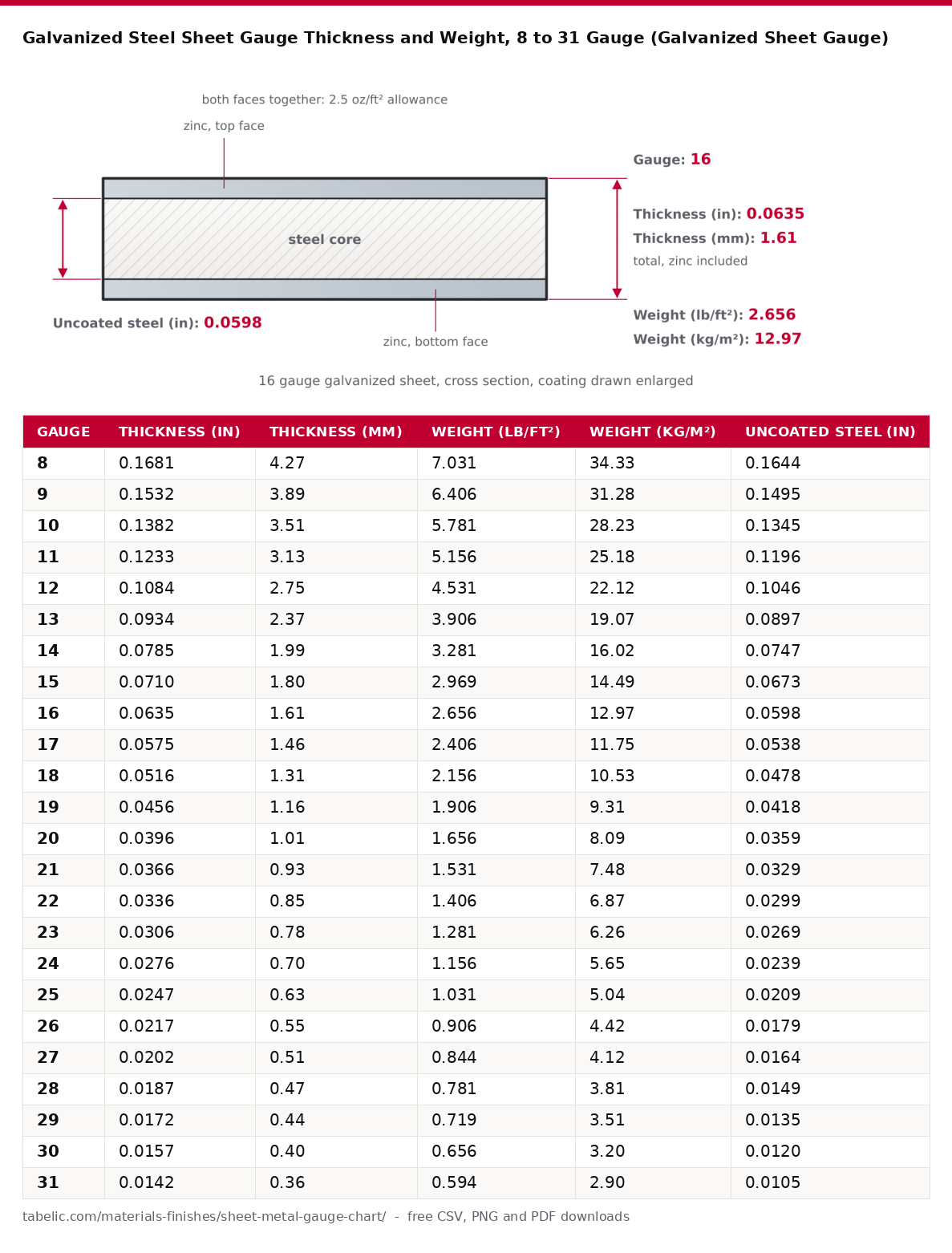
Galvanized Steel Sheet Gauge Thickness and Weight, 8 to 31 Gauge (Galvanized Sheet Gauge)

| Gauge | Thickness (in) | Thickness (mm) | Weight (lb/ft²) | Weight (kg/m²) | Uncoated steel (in) |
|---|---|---|---|---|---|
| 8 | 0.1681 | 4.27 | 7.031 | 34.33 | 0.1644 |
| 9 | 0.1532 | 3.89 | 6.406 | 31.28 | 0.1495 |
| 10 | 0.1382 | 3.51 | 5.781 | 28.23 | 0.1345 |
| 11 | 0.1233 | 3.13 | 5.156 | 25.18 | 0.1196 |
| 12 | 0.1084 | 2.75 | 4.531 | 22.12 | 0.1046 |
| 13 | 0.0934 | 2.37 | 3.906 | 19.07 | 0.0897 |
| 14 | 0.0785 | 1.99 | 3.281 | 16.02 | 0.0747 |
| 15 | 0.0710 | 1.80 | 2.969 | 14.49 | 0.0673 |
| 16 | 0.0635 | 1.61 | 2.656 | 12.97 | 0.0598 |
| 17 | 0.0575 | 1.46 | 2.406 | 11.75 | 0.0538 |
| 18 | 0.0516 | 1.31 | 2.156 | 10.53 | 0.0478 |
| 19 | 0.0456 | 1.16 | 1.906 | 9.31 | 0.0418 |
| 20 | 0.0396 | 1.01 | 1.656 | 8.09 | 0.0359 |
| 21 | 0.0366 | 0.93 | 1.531 | 7.48 | 0.0329 |
| 22 | 0.0336 | 0.85 | 1.406 | 6.87 | 0.0299 |
| 23 | 0.0306 | 0.78 | 1.281 | 6.26 | 0.0269 |
| 24 | 0.0276 | 0.70 | 1.156 | 5.65 | 0.0239 |
| 25 | 0.0247 | 0.63 | 1.031 | 5.04 | 0.0209 |
| 26 | 0.0217 | 0.55 | 0.906 | 4.42 | 0.0179 |
| 27 | 0.0202 | 0.51 | 0.844 | 4.12 | 0.0164 |
| 28 | 0.0187 | 0.47 | 0.781 | 3.81 | 0.0149 |
| 29 | 0.0172 | 0.44 | 0.719 | 3.51 | 0.0135 |
| 30 | 0.0157 | 0.40 | 0.656 | 3.20 | 0.0120 |
| 31 | 0.0142 | 0.36 | 0.594 | 2.90 | 0.0105 |
Galvanized Sheet Gauge: weight = Manufacturers' Standard Gauge steel weight + 2.5 oz/ft² (0.15625 lb/ft²), thickness = weight / 41.82. Nominal coated values.
Look up the gauge and read the coated thickness and weight. Note that for the same gauge number, the galvanized gauge are thicker than the bare steel gauge. That's because the galvanized gauge has two sides of zinc coating, whereas bare steel doesn't have any coating at all. The final column indicate the thickness of the uncoated Manufacturer's Standard Gauge used to make the galvanized gauge.
Galvanized sheet gauge. = Gauge
Thickness (in) and Thickness (mm) is the thickness in inches or millimeters, including zinc.
Weight (lb/ft²) and Weight (kg/m²) is the coated weight per unit area in pounds/square foot or kilograms/square meter.
Uncoated steel (in) is the thickness for the same gauge number, but it is bare uncoated steel from the standard steel table.
Weight determines the gauge used for galvanized steel: the standard steel weight plus 2.5 oz/ft² (0.15625 lb/ft²) of zinc. The thickness of each gauge are the total weight divided by 41.82 lb/ft² per inch; so the difference between a 16 gauge galvanized sheet and an equivalent bare sheet will be roughly 0.0037 in (0.09 mm). A 16 gauge galvanized sheet would therefore be 0.0635 in while the same uncoated piece would be 0.0598 in.
The problem is that people measure the galvanized sheet and compare it to the bare steel table. They think it’s a gauge heavier than ordered.
The other problem is they assume that the gauge indicates the coating. That isn’t true anymore. Coatings is now called out on their own.
In ASTM A653 they’re G60 or G90. In EN 10346 they’re Z180 or Z275. The G90 refers to a coating weight of 0.90 oz/ft² total for both faces. That’s far less than what the gauge would indicate. It’s also why commercial galvanized sheet will be slightly thinner than indicated by this table.
The gauge is still commonly found on drawings and in duct construction standards for HVAC duct, flashing, roofing and enclosures.
If you have a spec that provides a minimum base metal thickness rather than a gauge, then compare it to the uncoated column. Don’t compare it to the coated one. This table doesn’t apply to stainless or aluminium sheet.
Stainless Steel Sheet Gauge Thickness and Weight, 7 to 31 Gauge (US Standard Gauge)

| Gauge | Thickness (in) | Thickness (mm) | Weight 304 (lb/ft²) | Weight 304 (kg/m²) | Carbon steel same gauge (in) |
|---|---|---|---|---|---|
| 7 | 0.1875 | 4.76 | 7.722 | 37.62 | 0.1793 |
| 8 | 0.1719 | 4.37 | 7.080 | 34.49 | 0.1644 |
| 9 | 0.1563 | 3.97 | 6.437 | 31.36 | 0.1495 |
| 10 | 0.1406 | 3.57 | 5.790 | 28.21 | 0.1345 |
| 11 | 0.1250 | 3.18 | 5.148 | 25.08 | 0.1196 |
| 12 | 0.1094 | 2.78 | 4.506 | 21.95 | 0.1046 |
| 13 | 0.0938 | 2.38 | 3.863 | 18.82 | 0.0897 |
| 14 | 0.0781 | 1.98 | 3.216 | 15.67 | 0.0747 |
| 15 | 0.0703 | 1.79 | 2.895 | 14.11 | 0.0673 |
| 16 | 0.0625 | 1.59 | 2.574 | 12.54 | 0.0598 |
| 17 | 0.0563 | 1.43 | 2.319 | 11.30 | 0.0538 |
| 18 | 0.0500 | 1.27 | 2.059 | 10.03 | 0.0478 |
| 19 | 0.0438 | 1.11 | 1.804 | 8.79 | 0.0418 |
| 20 | 0.0375 | 0.95 | 1.544 | 7.52 | 0.0359 |
| 21 | 0.0344 | 0.87 | 1.417 | 6.90 | 0.0329 |
| 22 | 0.0313 | 0.80 | 1.289 | 6.28 | 0.0299 |
| 23 | 0.0281 | 0.71 | 1.157 | 5.64 | 0.0269 |
| 24 | 0.0250 | 0.64 | 1.030 | 5.02 | 0.0239 |
| 25 | 0.0219 | 0.56 | 0.902 | 4.39 | 0.0209 |
| 26 | 0.0188 | 0.48 | 0.774 | 3.77 | 0.0179 |
| 27 | 0.0172 | 0.44 | 0.708 | 3.45 | 0.0164 |
| 28 | 0.0156 | 0.40 | 0.642 | 3.13 | 0.0149 |
| 29 | 0.0141 | 0.36 | 0.581 | 2.83 | 0.0135 |
| 30 | 0.0125 | 0.32 | 0.515 | 2.51 | 0.0120 |
| 31 | 0.0109 | 0.28 | 0.449 | 2.19 | 0.0105 |
Stainless follows the US Standard Gauge (fractional inch values). Weight uses 304/316 density 7.9 g/cm³ (0.286 lb/in³); 400 series is about 2 percent lighter.
Read it to compare the gauge and the stainless thickness, then find the weight per square foot and per square metre. See also the last column which are the carbon steel thickness corresponding to the same gauge number.
This is always thinner. So when you order 16 gauge stainless, don't expect 16 gauge mild steel at 0.0598 in, but rather 0.0625 in (1.59 mm).
Stainless sheet suppliers follows the 1893 US Standard Gauge, which is called gauge. The nominal thicknesses is given in both inches and millimetres, and these were based off simple fractions of an inch. So 10 gauge is 9/64 in thick, 11 gauge is 1/8 in thick and 16 gauge is 1/16 in thick.
Austenitic stainless such as 304 or 316 is given a weight of 7.9 g/cm³ (0.286 lb/in³), which is used to calculate the Weight 304 (lb/ft²) and Weight 304 (kg/m²) values. To compare this different than carbon steel, the Manufacturers' Standard Gauge gives the same gauge in inches.
Stainless varies a couple of percent from supplier to supplier. Each chart have a slightly different assumed density. For example, charts using 0.280 lb/in³ density yield 16 gauge at 2.52 lb/ft². Some distributors shows 2.625 lb/ft².
The ferritic and martensitic 400 series alloys like 430 has about 2 percent less mass than 304. When lifting or shipping weight is critical, use the mill certificate weight.
Many published charts round off the odd gauges; for instance, they list 26 gauge at 0.019 in, and 13 gauge at 0.094 in. That’s the same sheet as the four decimal values here.
The general spec for stainless flat products (ASTM A480) discourages use of gauge numbers, and stainless is more commonly ordered today by metric or decimal thickness. Stainless sheet in the metric market is stocked in round millimetre size which don’t align with a gauge number precisely. Below is the metric table.
Stainless tubing is generally specified in terms of Birmingham wire gauge and the table doesn’t apply for that material. To give you a reference point, 16 BWG = .065 in.
Stainless strip and foil are sold in decimal thickness. This material is not covered by this table.
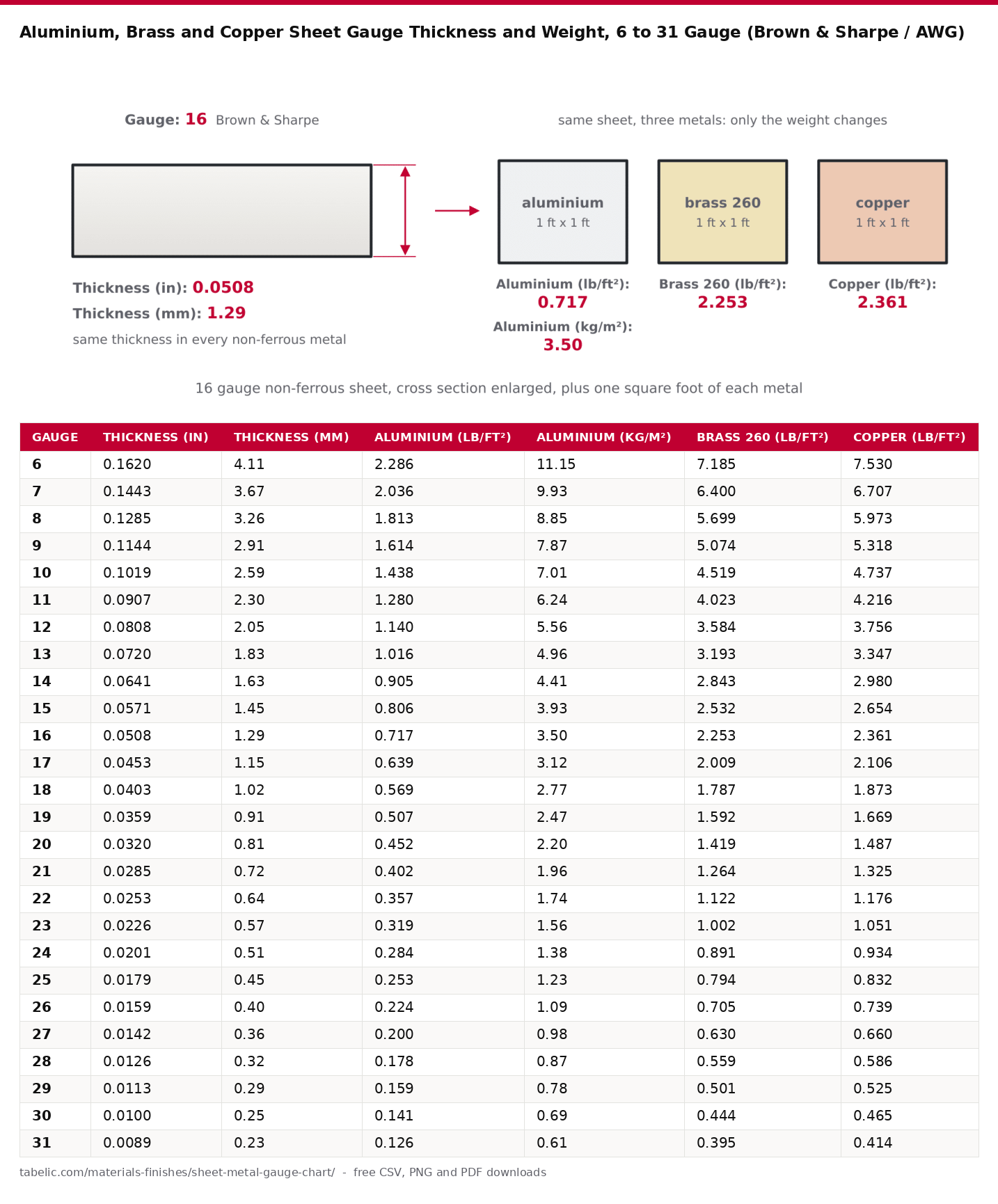
Aluminium, Brass and Copper Sheet Gauge Thickness and Weight, 6 to 31 Gauge (Brown & Sharpe / AWG)

| Gauge | Thickness (in) | Thickness (mm) | Aluminium (lb/ft²) | Aluminium (kg/m²) | Brass 260 (lb/ft²) | Copper (lb/ft²) |
|---|---|---|---|---|---|---|
| 6 | 0.1620 | 4.11 | 2.286 | 11.15 | 7.185 | 7.530 |
| 7 | 0.1443 | 3.67 | 2.036 | 9.93 | 6.400 | 6.707 |
| 8 | 0.1285 | 3.26 | 1.813 | 8.85 | 5.699 | 5.973 |
| 9 | 0.1144 | 2.91 | 1.614 | 7.87 | 5.074 | 5.318 |
| 10 | 0.1019 | 2.59 | 1.438 | 7.01 | 4.519 | 4.737 |
| 11 | 0.0907 | 2.30 | 1.280 | 6.24 | 4.023 | 4.216 |
| 12 | 0.0808 | 2.05 | 1.140 | 5.56 | 3.584 | 3.756 |
| 13 | 0.0720 | 1.83 | 1.016 | 4.96 | 3.193 | 3.347 |
| 14 | 0.0641 | 1.63 | 0.905 | 4.41 | 2.843 | 2.980 |
| 15 | 0.0571 | 1.45 | 0.806 | 3.93 | 2.532 | 2.654 |
| 16 | 0.0508 | 1.29 | 0.717 | 3.50 | 2.253 | 2.361 |
| 17 | 0.0453 | 1.15 | 0.639 | 3.12 | 2.009 | 2.106 |
| 18 | 0.0403 | 1.02 | 0.569 | 2.77 | 1.787 | 1.873 |
| 19 | 0.0359 | 0.91 | 0.507 | 2.47 | 1.592 | 1.669 |
| 20 | 0.0320 | 0.81 | 0.452 | 2.20 | 1.419 | 1.487 |
| 21 | 0.0285 | 0.72 | 0.402 | 1.96 | 1.264 | 1.325 |
| 22 | 0.0253 | 0.64 | 0.357 | 1.74 | 1.122 | 1.176 |
| 23 | 0.0226 | 0.57 | 0.319 | 1.56 | 1.002 | 1.051 |
| 24 | 0.0201 | 0.51 | 0.284 | 1.38 | 0.891 | 0.934 |
| 25 | 0.0179 | 0.45 | 0.253 | 1.23 | 0.794 | 0.832 |
| 26 | 0.0159 | 0.40 | 0.224 | 1.09 | 0.705 | 0.739 |
| 27 | 0.0142 | 0.36 | 0.200 | 0.98 | 0.630 | 0.660 |
| 28 | 0.0126 | 0.32 | 0.178 | 0.87 | 0.559 | 0.586 |
| 29 | 0.0113 | 0.29 | 0.159 | 0.78 | 0.501 | 0.525 |
| 30 | 0.0100 | 0.25 | 0.141 | 0.69 | 0.444 | 0.465 |
| 31 | 0.0089 | 0.23 | 0.126 | 0.61 | 0.395 | 0.414 |
Brown & Sharpe (same series as AWG): t = 0.005 x 92^((36 - n) / 39) in. Densities: aluminium 2.71, brass C26000 8.53, copper 8.94 g/cm³.
Read off the thickness (in inches and millimeters) on the gauge, then the weight per square foot (of that metal, either aluminum, brass or copper).
The Brown & Sharpe gauge is what’s used for non-ferrous sheet. For any given number, thickness is the same across all three metals, but the weight vary. For example, 16 gauge aluminum is 0.0508 in (1.29 mm); by comparison, it’s far thinner than steel with the same number: steel is 0.0598 in.
The Brown & Sharpe number is the gauge. The B&S formula give Thickness (mm) and Thickness (in). For example, 0000 = 0.46 in and 36 = 0.005 in. Each gauge is approximately 1.123 times thicker than the next thinner gauge, forming a geometric series.
The remaining numbers is Aluminum (kg/m²) and Aluminum (lb/ft²) for common aluminum alloy like 6061, 5052, 3003, and 1100 at a density of 2.71 g/cm³ (0.098 lb/in³). Other numbers include Brass 260 (lb/ft²), which is cartridge brass C26000 at 8.53 g/cm³, and Copper (lb/ft²), which is pure copper at 8.94 g/cm³.
Brown & Sharpe numbers is the same number series as American Wire Gauge (AWG). The number 12 means both 12 gauge aluminum sheet and 12 AWG wire have a value of 0.0808 in, where one is a thickness and the other is a diameter. This table isn't for wire sizes; use our Wire Gauge Chart for that.
Aluminium sheet in North America comes in decimal thickness, such as 0.032, 0.040, 0.063, 0.080, and 0.125 in. These decimals are how the metal is typically sold and kept in stock, rather than by gauge. For example, 14 gauge is 0.0641 in, but the sheet you recieve may be 0.063 in. Check the decimal when you order. The B&S numbers are similar but not identical.
But more often, when roofing and flashing copper sheet are called out, they are listed not by gauge but by weight, in ounces per square foot. A 16 oz copper is around 0.0216 in, between 23 and 24 gauge; a 20 oz is about 0.027 in, right between 21 and 22 gauge.
Some sellers will also list copper using a Birmingham or Stubs gauge (16 gauge = 0.065 in). Make sure you know which gauge a copper chart is using before you take a gauge number at face value.
Also, there is slight differences in alloys within each metal. Brass ranges from about 8.4 to 8.7 g/cm³ and 6061 aluminum is 2.70 g/cm³. Therefore, the weight are good to a few percent for any common alloy of that metal. You should of checked the moddern chart.
Metric Sheet Thickness to Nearest Gauge by Material (Steel, Galvanized, Stainless, Aluminium)

| Metric sheet (mm) | Inch equivalent (in) | Steel gauge (mm) | Galvanized gauge (mm) | Stainless gauge (mm) | Aluminium gauge (mm) |
|---|---|---|---|---|---|
| 0.4 | 0.0157 | 27 ga (0.42) | 30 ga (0.40) | 28 ga (0.40) | 26 ga (0.40) |
| 0.5 | 0.0197 | 25 ga (0.53) | 27 ga (0.51) | 26 ga (0.48) | 24 ga (0.51) |
| 0.55 | 0.0217 | 25 ga (0.53) | 26 ga (0.55) | 25 ga (0.56) | 23 ga (0.57) |
| 0.6 | 0.0236 | 24 ga (0.61) | 25 ga (0.63) | 24 ga (0.64) | 23 ga (0.57) |
| 0.7 | 0.0276 | 23 ga (0.68) | 24 ga (0.70) | 23 ga (0.71) | 21 ga (0.72) |
| 0.75 | 0.0295 | 22 ga (0.76) | 23 ga (0.78) | 23 ga (0.71) | 21 ga (0.72) |
| 0.8 | 0.0315 | 21 ga (0.84) | 23 ga (0.78) | 22 ga (0.80) | 20 ga (0.81) |
| 0.9 | 0.0354 | 20 ga (0.91) | 21 ga (0.93) | 21 ga (0.87) | 19 ga (0.91) |
| 1 | 0.0394 | 19 ga (1.06) | 20 ga (1.01) | 20 ga (0.95) | 18 ga (1.02) |
| 1.2 | 0.0472 | 18 ga (1.21) | 19 ga (1.16) | 18 ga (1.27) | 17 ga (1.15) |
| 1.25 | 0.0492 | 18 ga (1.21) | 18 ga (1.31) | 18 ga (1.27) | 16 ga (1.29) |
| 1.5 | 0.0591 | 16 ga (1.52) | 17 ga (1.46) | 17 ga (1.43) | 15 ga (1.45) |
| 1.6 | 0.0630 | 16 ga (1.52) | 16 ga (1.61) | 16 ga (1.59) | 14 ga (1.63) |
| 2 | 0.0787 | 14 ga (1.90) | 14 ga (1.99) | 14 ga (1.98) | 12 ga (2.05) |
| 2.5 | 0.0984 | 12 ga (2.66) | 13 ga (2.37) | 13 ga (2.38) | 10 ga (2.59) |
| 3 | 0.1181 | 11 ga (3.04) | 11 ga (3.13) | 11 ga (3.18) | 9 ga (2.91) |
| 4 | 0.1575 | 8 ga (4.18) | 9 ga (3.89) | 9 ga (3.97) | 6 ga (4.11) |
| 5 | 0.1969 | 6 ga (4.94) | - | 7 ga (4.76) | - |
| 6 | 0.2362 | 3 ga (6.07) | - | - | - |
Nearest gauge by nominal thickness, actual gauge thickness in brackets. Blank = no gauge within 12 percent. Order metric stock by mm, not by gauge.
The first column list the metric sheet thickness you're after/already have. The rest of the columns are for the different materials. Read across to find out what gauge number is closest to your chosen thickness. The cells display the corresponding gauge and it's nominal thickness in mm (in brackets). This shows you just how close the match is.
Metric sheet (mm) are the commonly stocked metric thickness. Inch equivalent (in) Exact conversion. Steel gauge (mm) use the manufacturers' standard gauge. The galvanized gauge (mm) refer to the galvanized sheet gauge. Stainless gauge (mm) is the US Standard Gauge for stainless steel. Aluminium gauge (mm) uses the Brown & Sharpe scale. Blank cell No gauge in this system is within 12 percent of the metric size.
In one view, this table illustrates the central trap of sheet gauges: they are all close but not exact; for example, 1.5 mm is closest to 16 gauge in steel, 15 gauge in aluminium, and 17 gauge in stainless and galvanized. On the other hand, 16 gauge on a drawing might be anything from 1.29 mm up to 1.61 mm, depending on the metal.
It is never a perfect gauge, and a metric sheet isn’t literaly a gauge either. While 16 gauge is .02 mm thicker then 1.5 mm of steel (within rolling tolerance), 2.5 mm is a 6 percent difference from 12 gauge steel at 2.66 mm, so that’s going to make a difference in press brake tooling, weld settings and bend allowances.
If your gauge drawing calls out an exact size that makes a difference in fit, strength, or fastener grip range, check with the designer before substituting a different thickness of metric stock. You should of checked based off the designer.
This table should be used as a translation from one system to another. To see the complete run of gauges and their weights, visit the material tables above.
Steel Sheet Gauge Thickness Tolerance, Nominal vs Minimum and Maximum (10 to 28 Gauge)

| Gauge | Nominal (in) | Nominal (mm) | Maximum (in) | Minimum (in) | Tolerance (in) | Tolerance (mm) |
|---|---|---|---|---|---|---|
| 10 | 0.1345 | 3.42 | 0.1405 | 0.1285 | ± 0.0060 | ± 0.15 |
| 11 | 0.1196 | 3.04 | 0.1256 | 0.1136 | ± 0.0060 | ± 0.15 |
| 12 | 0.1046 | 2.66 | 0.1106 | 0.0986 | ± 0.0060 | ± 0.15 |
| 14 | 0.0747 | 1.90 | 0.0797 | 0.0697 | ± 0.0050 | ± 0.13 |
| 16 | 0.0598 | 1.52 | 0.0648 | 0.0548 | ± 0.0050 | ± 0.13 |
| 18 | 0.0478 | 1.21 | 0.0518 | 0.0438 | ± 0.0040 | ± 0.10 |
| 20 | 0.0359 | 0.91 | 0.0389 | 0.0329 | ± 0.0030 | ± 0.08 |
| 22 | 0.0299 | 0.76 | 0.0329 | 0.0269 | ± 0.0030 | ± 0.08 |
| 24 | 0.0239 | 0.61 | 0.0269 | 0.0209 | ± 0.0030 | ± 0.08 |
| 26 | 0.0179 | 0.45 | 0.0199 | 0.0159 | ± 0.0020 | ± 0.05 |
| 28 | 0.0149 | 0.38 | 0.0169 | 0.0129 | ± 0.0020 | ± 0.05 |
Typical commercial tolerance for cold rolled carbon steel sheet; the gauge system itself defines no tolerance. Check the mill's ASTM A568 class or order spec.
The way this works is that you look at the gauge and see what the standard thickness is, then you figure out what the min and max are for a given sheet to be that gauge within normal commercial tolerances. If your reading on a caliper or micrometer fall between those min/max values it matches the nominal gauge.
The Mfg. The Standard Gauge number is shown as Gauge. The actual gauge thickness from the steel table in inches and millimeters are shown as Nominal (in) & Nominal (mm).
To find the minimum and maximum inches, add and subtract the tolerance from the nominal value. These is shown as Minimum (in), Maximum (in), Tolerance (mm), and Tolerance (in).
On thin sheet, one gauge overlaps the next. The tolerance band for a 20 gauge overlap with that of a 22 gauge, and the 26 gauge overlap with the 28 gauge (about 0.016 to 0.017 in).
Never assume you know a gauge by just taking a reading of its thickness on thin sheet. Because rolled sheet tend to be slightly thinner around the edges, you take multiple measurement away from the edge.
There is no tolerance specified by the Manufacturers' Standard Gauge. Instead, these numbers represent typical commercial practice for cold rolled; the actual tolerance will follow the product spec.
For cold rolled, you refer to ASTM A568 and A1008, for hot rolled, A1011 and for galvanized, A653.
Depending on sheet width and if you have specified tighter restricted tolerances, that will affect the tolerance as well. In cases where thickness is critical, rather than a gauge, you would of specified a minimum thickness on the order.
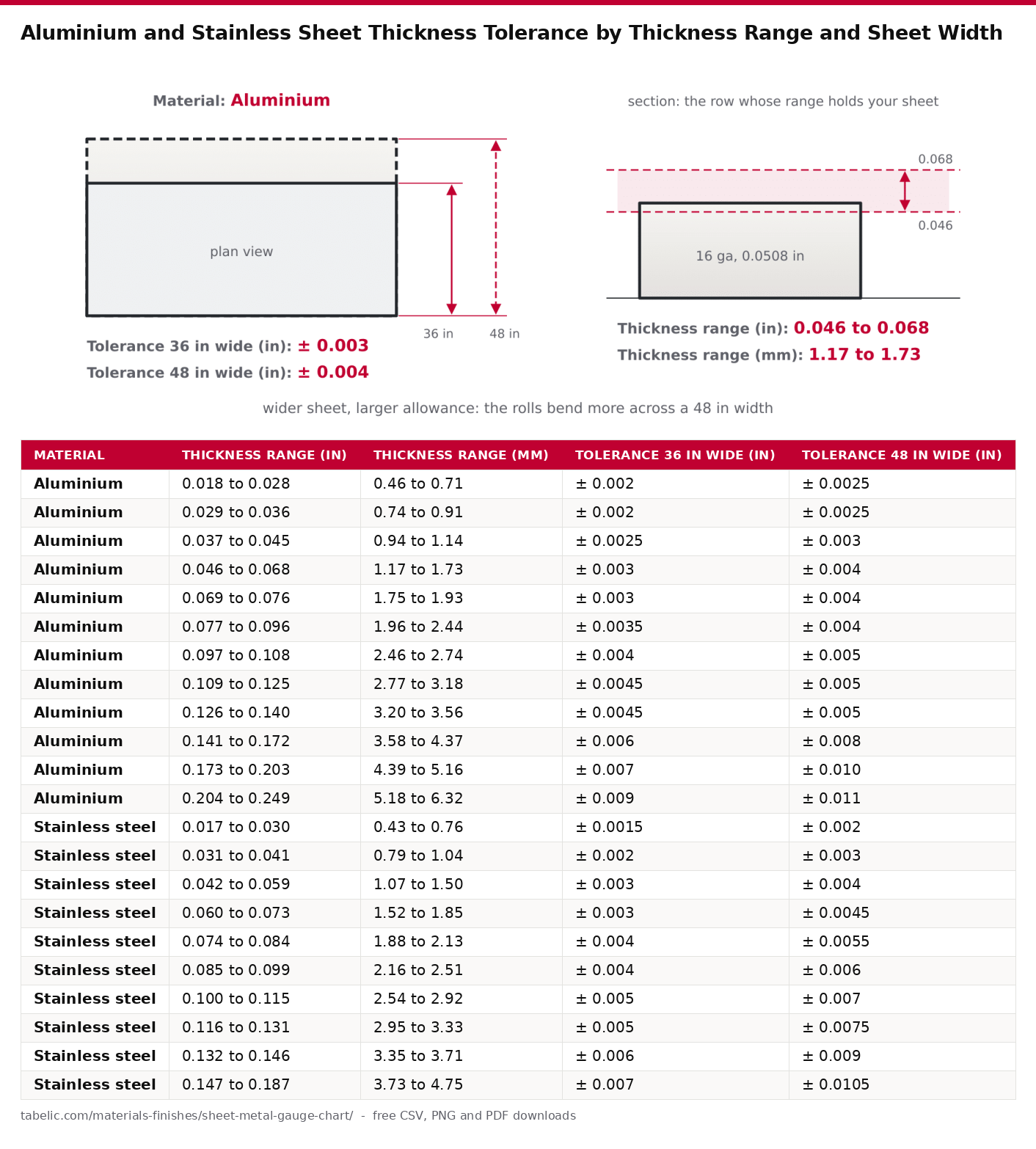
Aluminium and Stainless Sheet Thickness Tolerance by Thickness Range and Sheet Width

| Material | Thickness range (in) | Thickness range (mm) | Tolerance 36 in wide (in) | Tolerance 48 in wide (in) |
|---|---|---|---|---|
| Aluminium | 0.018 to 0.028 | 0.46 to 0.71 | ± 0.002 | ± 0.0025 |
| Aluminium | 0.029 to 0.036 | 0.74 to 0.91 | ± 0.002 | ± 0.0025 |
| Aluminium | 0.037 to 0.045 | 0.94 to 1.14 | ± 0.0025 | ± 0.003 |
| Aluminium | 0.046 to 0.068 | 1.17 to 1.73 | ± 0.003 | ± 0.004 |
| Aluminium | 0.069 to 0.076 | 1.75 to 1.93 | ± 0.003 | ± 0.004 |
| Aluminium | 0.077 to 0.096 | 1.96 to 2.44 | ± 0.0035 | ± 0.004 |
| Aluminium | 0.097 to 0.108 | 2.46 to 2.74 | ± 0.004 | ± 0.005 |
| Aluminium | 0.109 to 0.125 | 2.77 to 3.18 | ± 0.0045 | ± 0.005 |
| Aluminium | 0.126 to 0.140 | 3.20 to 3.56 | ± 0.0045 | ± 0.005 |
| Aluminium | 0.141 to 0.172 | 3.58 to 4.37 | ± 0.006 | ± 0.008 |
| Aluminium | 0.173 to 0.203 | 4.39 to 5.16 | ± 0.007 | ± 0.010 |
| Aluminium | 0.204 to 0.249 | 5.18 to 6.32 | ± 0.009 | ± 0.011 |
| Stainless steel | 0.017 to 0.030 | 0.43 to 0.76 | ± 0.0015 | ± 0.002 |
| Stainless steel | 0.031 to 0.041 | 0.79 to 1.04 | ± 0.002 | ± 0.003 |
| Stainless steel | 0.042 to 0.059 | 1.07 to 1.50 | ± 0.003 | ± 0.004 |
| Stainless steel | 0.060 to 0.073 | 1.52 to 1.85 | ± 0.003 | ± 0.0045 |
| Stainless steel | 0.074 to 0.084 | 1.88 to 2.13 | ± 0.004 | ± 0.0055 |
| Stainless steel | 0.085 to 0.099 | 2.16 to 2.51 | ± 0.004 | ± 0.006 |
| Stainless steel | 0.100 to 0.115 | 2.54 to 2.92 | ± 0.005 | ± 0.007 |
| Stainless steel | 0.116 to 0.131 | 2.95 to 3.33 | ± 0.005 | ± 0.0075 |
| Stainless steel | 0.132 to 0.146 | 3.35 to 3.71 | ± 0.006 | ± 0.009 |
| Stainless steel | 0.147 to 0.187 | 3.73 to 4.75 | ± 0.007 | ± 0.0105 |
Typical commercial plus or minus thickness tolerance by range and width. The purchase spec (ASTM B209 aluminium, ASTM A480 stainless) governs.
Use the material and thickness range to find the right row, then read the plus or minus allowance for a 36 in or 48 in wide sheet. Read down until you find the row that includes thickness of your sheet and then the plus or minus allowance for a 36 in or 48 in wide sheet.
Because the roll deflects more across a wider width, the wider the sheet the greater the tolerance. These tolerances is not based off gauge but on the thickness range. Unlike carbon steel, the tolerance is not based on gauge.
The material is either stainless steel or aluminium. The thickness range columns indicates the nominal thickness band in both inches and millimeters. The tolerance columns indicate the plus or minus allowance on the nominal thickness for sheets up to those widths.
For instance, 16 gauge aluminium (0.0508 in) is in the 0.046 to 0.068 in band. Therefore, a 48 in wide sheet might be 0.0468 to 0.0548 in.
And 16 gauge stainless (0.0625 in) are in the 0.060 to 0.073 in band. So a 48 in sheet might be 0.0580 to 0.0670 in.
This is a list of normal commercial tolerances that are published. The purchase specification governs them, such as ASTM A480 for stainless flat products or ASTM B209 for aluminium sheet.
They will also vary depending on the alloy, the temper and if it's over 48 in wide. If it's a precision part then state what thickness tolerance you require on your drawing. You should of checked the spec first.
References
- Sheet metal gauge sizes table: steel, galvanized, stainless, aluminium, B&S weights and tolerances - Engineers Edge
- Gauge and weight chart for sheet steel, galvanized, stainless and aluminium (PDF) - Continental Steel & Tube
- 300 series stainless sheet, 16 gauge 0.0625 in, weight per square foot - Continental Steel & Tube
- Sheet metal gauge charts for steel, aluminium, stainless, galvanized, brass and copper - Metal Supermarkets
- Sheet metal: gauge systems, 41.82 lb/ft² per inch basis and thickness tolerances - Wikipedia
- American wire gauge: Brown & Sharpe geometric formula - Wikipedia
- SAE 304 stainless steel: density - Wikipedia
- 6061 aluminium alloy: density - Wikipedia
- Brass and cartridge brass: density range - Wikipedia
- Copper: density - Wikipedia
Chart images



These tables are provided for general reference only. Always verify the values against the governing standard, your supplier's documentation or a qualified engineer before relying on them for your industrial use case, especially in safety-critical work.